


When you think of healthcare, your mind probably first goes to health insurance. And rightfully so. If you’re from the U.S., it is one of your largest monthly expenditures.
Recently, my son experienced an allergic reaction that, initially, seemed mild. By afternoon, we were concerned enough to take him to our nearest urgencia to get checked out.
We walked in, handed over his TIE and insurance cards, explained to the receptionist why we were there, and she quickly escorted my son and me back to pediatric triage. Within minutes, a pediatrician met with us to assess whether his reaction would need further care.
As it turned out, he did need further care, and the doctor kept him for a couple of hours after administering epinephrine.
A week later, we met with an allergist for allergy testing, bloodwork, and ultimately, she prescribed Anapen, the Spanish equivalent of an EpiPen.
Later, at the pharmacy, I expected to spend more than €100 for the Anapen. In the U.S., an EpiPen will cost more than $150 using a GoodRx coupon. If you’re lucky enough to have “good” health insurance, you’ll have a copay to offset the worst of the cost, but the copay is variable. Otherwise … blah, blah, blah. You know the American health insurance drill.
You can see how this all very quickly becomes expensive—and complicated.
I whipped out my credit card to pay for the Anapen, and the pharmacist said:
“€42.09.”
My mouth must’ve dropped open a bit in shock because she smiled as she took the payment and bid me a good day.
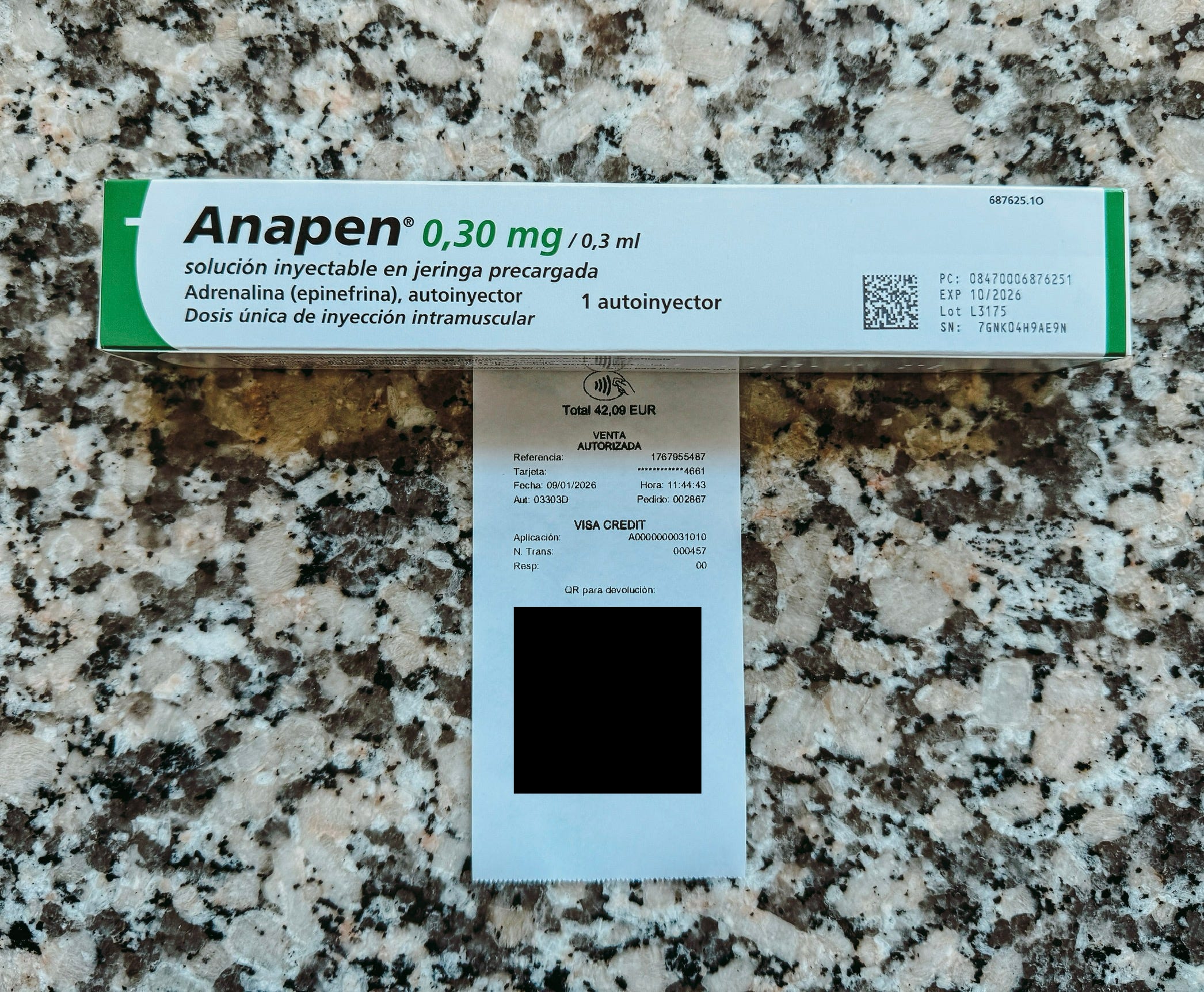
Having been in Spain for nearly a year and a half, I’m still caught off guard by how affordable prescriptions are—and the cost is fairly consistent from pharmacy to pharmacy.
Ninety days of propranolol? €2.00.
Testosterone injections? €10.00.
Estradiol gel? €17.00.
When you use private healthcare in Spain, unlike in the U.S., your prescriptions won’t typically be covered by insurance. Instead, you can expect to pick up your prescriptions at the pharmacy, pay out of pocket, and be pleasantly surprised by the cost in most cases.
So how is Spain able to do this?
Prescription costs are subsidized via taxes and negotiations with drug companies.
Without getting into the politics, there is a public healthcare system. The cost of prescriptions ties back to how that system as a whole works. As a relatively new Spanish resident, I don’t entirely understand it yet.
Outside of prescription drugs, I find that over-the-counter drug costs can vary. Some are less expensive than those in the U.S., others are more. But for the prescriptions you really need?
Spain does a remarkably good job of ensuring everyone has access to the healthcare they require.
I write here about building a life abroad—slowly, imperfectly, and with a lot of trial and error.
You can subscribe to receive new posts by email, or support this work with a paid subscription, one-time contribution, or just hit the ❤️ button below to help others find poco a poco.
If you’d like to reach out directly, you can find me at jen@jeninspain.com.
More reading on healthcare in Spain:
Doing Healthcare the Spanish Way

One of the questions I often get about living abroad is about healthcare. After all, healthcare in the United States is anything but straightforward. As an adult, you have to learn how to navigate a maze of deductibles, copays, out-of-pocket maxes, denials, appeals, and much, much more.
Sick in Spain

Walk into any Walmart, Target, Kroger, or Publix in the U.S., and you can buy a pantry’s worth of over-the-counter medications. There are aisles and aisles of pain relievers, cough syrup, allergy medications, eye drops, and more. It’s a self-medicating paradise for those who dislike going to the doctor (or who can’t afford to go).